
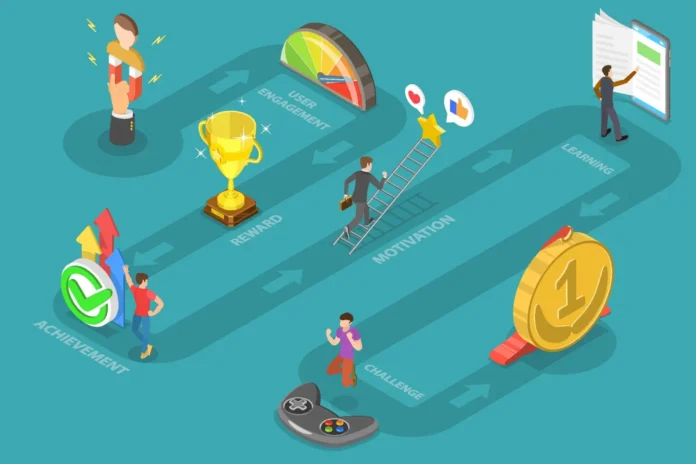

Theories of Motivation Underpinnings Maslow, Deci and Ryan, and the Reinforcement Theory.
The Hierarchy of Needs: Maslow and the priority of personal development.
The difference between declaring high course completion rates and actual behavior change is still a challenge in the constantly changing context of corporate training. Conventionally, the methods do not work, as they make learning a passive task, but not an active endeavor.
Nevertheless, the inclusion of cognitive reinforcement components in learning and psychology of game-based learning might revitalize the training programs and produce transformational outcomes. The blog discusses the interrelationship between gamification motivation psychology and behavioral science in training and points to the role of motivation theories such as Maslows and Deci Ryan in driving employee learning behavior.
The essence of cognitive reinforcement in learning consists in the comprehension of the Maslow’s Hierarchy of Needs – the system of human motivation that consists of levels, starting with simple (physiological) and going up to more complicated (self-actualization). In the corporate learning contexts, employees will tend to be more involved when their learning experience is in line with such higher needs of esteem and self actualization.
The game-based methods like those that are promoted by the internal sources like references on the psychological theory can be very effective in increasing the employee learning behavior by fostering these high-level needs. In order to discover how this framework can revolutionize learning systems, immerse into gamifying education.
Self Determination Theory (SDT): Intrinsic Motivation.
The SDT suggested by Deci and Ryan highlights autonomy, competence, and relatedness as key to intrinsic motivation gamification. Workers are motivated when they are given the freedom to decide their learning styles, experience that they are in control of their skills, and when they feel that they belong. The combination of these concepts makes gamification motivation psychology an effective facilitator of the work culture in which intrinsic motivation thrives, which is the focus of synergy-oriented SDT references. Boost your knowledge on these techniques with the introduction of gamification in business learning.
Reinforcement Theory: How to Change Behaviors by getting Real-time Feedback.
The behavior of employee learning is necessary to be positively reinforced. Conventional training is normally ineffective because it gives delayed or insignificant reinforcement. The game-based learning works however by providing immediate, relevant feedback, which enhances the cognitive reinforcement in learning. This immediate reinforcement helps to create strong mental habits by the feedback loop, which is advocated by the references of behaviorism that highlight the significance of the immediate reinforcement. Find ways of keeping the learning games based on scenarios immediately engaged.
How Gamification Fits In- Extrinsic and intrinsic Motivators.
Intrinsic and Extrinsic Motivation in Learning.
Learning activities work best with intrinsic motivators like curiosity and mastery and external rewards that include badges as a way of getting engaged with it. The thing here is to balance this; excess use of extrinsic rewards can crowd out the intrinsic motivations. Superficial pointsification should be avoided, but rather meaningful rewards should be included to supplement the intrinsic drives, which is the effect of good gamification motivation psychology. To have an equal portion of these motivators, acquaint yourself with our article on the benefits of gamification in learning.
The justification of Intrinsic Motivation by Gamification.
Incorporating gamification with intrinsic motivation entails strengthening of autonomy, competence, and relatedness. These fundamental needs are associated with platforms that provide their own-chosen paths and shared missions, facilitating the development of employees. Gamification of Training and Development presents workable ways to make use of these structures, making sure that gamification empowers, not kills intrinsic motivation.
Combining Extrinsic Rewards with Strengthening Intrinsic Motivation.
Whereas extrinsic rewards might be used to generate the engagement, they must always strive to open up new challenges and get deeper into thought. Badges and leaderboards are good as long as they are associated with the actual skill learning and development. This considered incorporation is what ensures extrinsic motivators do not undermine intrinsic drives as was observed in gamification research. Think more about this issue with training gamification mechanics.
Cognitive Triggers Feedback, Autonomy, Progress Tracking.
Short Term, Timely Feedback.
Feedback The active learning process is based on feedback. Immediate corrections and feedback can be used to enhance cognitive reinforcement in the learning process thus every training session is effective. Feedback loop research indicates that this immediate feedback is essential in formation of a habit developing a better knowledge of right behaviors. Get to know more about the process of optimizing feedback mechanisms using gamification in corporate training.
The Autonomy as a Cognitive Trigger.
Choice-based learning is an exciting activity as well as a retention activity. Employee empowerment by giving them freedom to choose courses and the difficulty of learning tasks renders learning a personal and unforgettable experience, which is the basis of intrinsic motivation gamification.
Progress Tracking
The visual representation of progress using XP bars and progress maps is very alluring to learners and they are motivated to complete tasks out of the Zeigarnik effect where pending activities become the focus of their thoughts. The cognitive reinforcement technique entrenches in the learning process, allowing one to engage in learning and achieve long-term effectiveness.
Patterns of Learning in employees -Attention, retention.
Attention Problems in the Modern Era.
The current employees are encountering a lot of distractions and it is important that they are introduced to effective learning sessions. Micro, short-learning modules can play an important role in improving the learning behavior of employees due to limited attention span at the modern workplaces.
Designing towards Short Sessions.
Successful learning plans alternate brief, powerful exercises in the schedule of a learner, which facilitates regular, small portions of interaction. Such a repetition is a more effective way of learning than longer and less frequent sessions, as it involves motivational learning strategies that employees can identify with. To explain further methods, visit our discussion on interactive microlearning.
Retention Spaced Repetition and Retrieval Practice.
Game-based learning psychology is very beneficial in memory-enhancement methods like spaced repetition and retrieval practice. These tactics help avoid forgetting and strengthen the memory with time to make the learning process a constant process.
Emotional Encoding
The use of narratives, time limits and social elements can increase the level of emotional involvement resulting in the enhancement of memory encoding because employees can connect emotionally to the training narratives.
Designing to encourage motivation- Badges, Levels, Storytelling.
Badges as Significant Progressions.
In the right hands, badges promote positive accomplishment in the learning behavior of employees, indicating actual mastery and propelling further action in the form of motivational learning strategies.
Levels & XP Systems
The competence growth is visible with levels and experience points, which fits the intrinsic motivation gamification. These factors make training an observable process through skill enhancement.
Telling Tales and Narration Framing.
Stories offer background and feeling and instill knowledge in the form of familiar constructs. Through the use of interesting stories, the learners will be emotionally engaged, which makes training outcomes better.
Quests & Missions
Quests put micro-challenges into meaningful missions, providing freedom in the learning courses. This builds on learning through the creation of different settings that facilitate exploration and repetition.
Social Mechanics
Game-based components of collaboration are a necessity, which encourages peer-support and responsibility. Through the creation of a collaborative atmosphere, not only do difficulties shift to a contention of isolated success but also a characteristic of intrinsic motivation gamification.
Case Snippets – Motivation-Based Learning Victories.
Narrative Quest Sales Enablement.
The game-based learning psychology shows that sales teams that are involved with scenario-based narratives have the ability to engage in voluntary practice and confidence as well as to learn and master a specific subject or topic.
Training Compliance Through Consequence-Based Situations.
Where instant feedback is provided during ethical decision making, understanding of compliance will improve, and routine training will become not just a motivational experience, but a motivated one.
Leveled and Skill Tree Based technical upskilling.
Advancing technical difficulty filled with level and peer feedback promote skill development, which proves to be effective motivational learning tactics that boost activity and expertise.
Summary The behavioral science can be effectively used in corporate L&D.
To achieve the change in case of corporate learning, the motivational and cognitive design should be given priority rather than content delivery alone. Learning based on cognitive reinforcement takes advantage of immediate feedback and independent decisions to promote sustained change of behavior. Higher engagement and visible improvements are realized in organizations that adopt game-based approaches based on behavioral science.
These strategies will not be achieved without advanced methods of gamification, which sometimes will mean the use of programs like Game-Based Learning and Gamification and the use of services of platforms like Unity Game Development Company to make the experience truly immersive. By considering motivation as part of L&D, companies can promote real change by way of learning that contemporary employees can relate to.
FAQs
What is cognitive reinforcement in which we learn?
Cognitive reinforcement refers to the provision of instant feedback and rewards to reinforce the desired behaviors where the learners develop a stronger mental relationship and long term memory.
What is the relationship between gamification and Maslow and SDT?
Gamification facilitates the autonomous, competent, and relatedness intrinsic drives promoted by Maslow and Deci and Ryan theories, respectively, by aligning game mechanics to higher-level needs and human motivations.
What is the importance of immediate feedback during corporate training?
Short feedback serves to allow learners to fix their errors in the moment by building a reward cycle that works and providing more long-lasting behavior change than delayed feedback or feedback that is negligible.